Quick Takeaways
- Website performance for small business directly affects three things simultaneously — search rankings, conversion rates, and the first impression your brand makes on every new visitor.
- Google uses Core Web Vitals as ranking signals. Sites that score well rank better than comparable sites that don’t — making performance a direct SEO factor, not just a user experience concern.
- A website that performed well at launch won’t necessarily perform well six months later. Performance degrades predictably through plugin updates, unoptimized images, and drifting caching configurations.
- Most business owners check their site from a fast, cached browser — experiencing a version dramatically better than what new mobile visitors actually encounter.
- Treating performance as an ongoing responsibility rather than a launch-day achievement is what separates websites that keep working for the business from those that quietly work against it.
Why Website Performance Is a Small Business Priority
Website performance for small business has quietly become one of the most important factors separating businesses that grow online from those that don’t.
It used to be treated as a technical concern — something developers handled behind the scenes, something that only mattered when a site became noticeably broken. That’s no longer true. Today, website performance for small business directly affects search rankings, visitor behavior, conversion rates, and the impression your brand makes before a single word of content is read.
Most small business owners don’t realize how much performance is costing them — because the cost is invisible. It doesn’t show up as an error message or a failed transaction. It shows up as visitors who left before the page loaded, rankings that quietly slipped, and leads that went to a competitor whose site was faster.
Why Website Performance for Small Business Affects Search Rankings
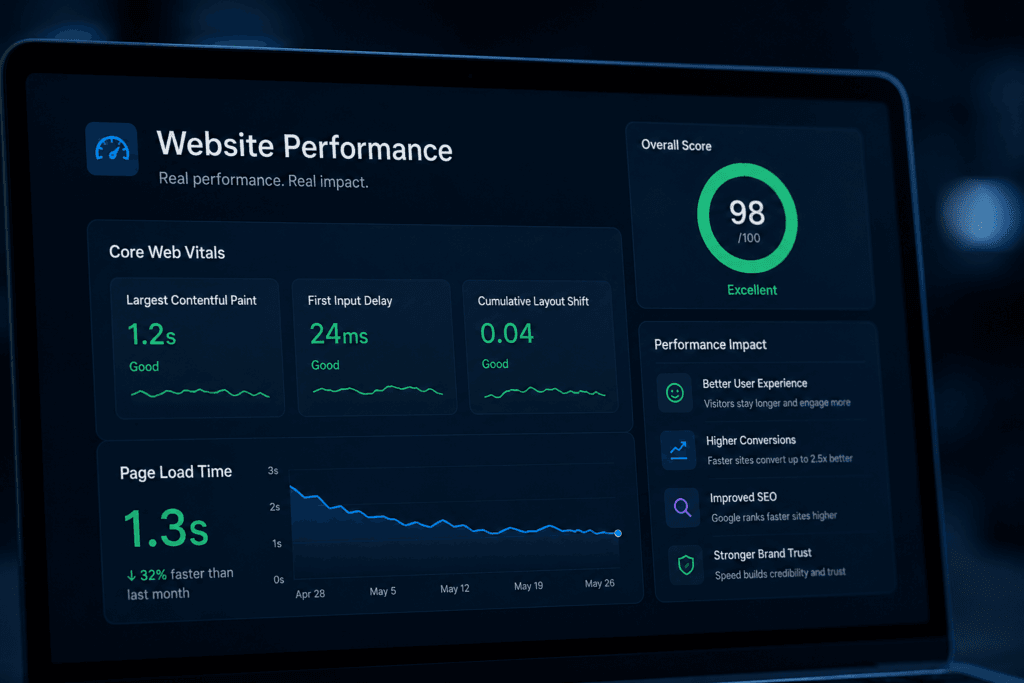
Google uses a set of standardized performance metrics called Core Web Vitals as direct ranking signals. These metrics measure how quickly your page loads, how stable the layout is as content appears, and how responsive the site feels to interaction.
Sites that score well on these metrics rank better than comparable sites that don’t. For small businesses competing in local markets or service categories where content quality among competitors is similar, performance scores can be the single differentiating factor between page one and page two visibility.
A competitor whose site loads in 1.5 seconds starts ahead of a competitor whose site loads in 4 seconds — even with equivalent content, backlinks, and authority. Understanding core web vitals for small business is the foundation of understanding how performance connects to the rankings that drive organic traffic to your business.
How Website Performance Affects Visitor Behavior
Beyond rankings, performance shapes what happens when visitors arrive.
Google’s research shows that as mobile page load time increases from one second to three seconds, the probability of a visitor bouncing increases by 32 percent. From one second to five seconds, that probability increases by 90 percent. These are visitors who found your site, clicked through, and left before seeing anything — because the page took too long.
For a small business where a website conversion means a contact form submission, a phone call, or a booking, losing that percentage of visitors to load time is a direct revenue cost that never appears on any report. A slow website losing customers is one of the most expensive problems a small business can have — precisely because it’s invisible.
Why Website Performance Degrades After Launch
One of the most important things to understand about website performance for small business is that it isn’t permanent.
A site that performed well at launch will not necessarily perform well six or twelve months later. Plugin updates add script weight. Images accumulate without compression. New integrations add third-party requests. Caching configurations drift out of alignment as the platform evolves.
Each change is individually minor. Collectively they produce a site that loads measurably slower than it did on launch day — and one that most business owners don’t notice, because they’re checking from a cached browser on a fast connection while every new visitor experiences the full accumulated degradation.
This is why why your website slows down after launch is one of the most practically important performance topics for small businesses. The causes are predictable. The prevention requires ongoing attention — not a one-time setup.
What Website Performance for Small Business Actually Requires
Good website performance for small business doesn’t mean matching enterprise platforms with dedicated engineering teams. It means achieving and maintaining scores that reflect well on the business and support search visibility over time.
Practically that means targeting Largest Contentful Paint under 2.5 seconds, Interaction to Next Paint under 200 milliseconds, and Cumulative Layout Shift under 0.1. Achieving these scores consistently — particularly on mobile — requires proper image optimization, smart script loading, well-configured caching, and regular performance monitoring.
Mobile website speed deserves particular attention. Google’s indexing is mobile-first — meaning your mobile performance scores are the ones that matter most for rankings. A site that performs well on desktop but poorly on mobile is being evaluated on its weaker performance.
The Business Case for Treating Performance as an Ongoing Priority
The businesses getting the most from their websites are the ones treating performance as an ongoing responsibility rather than a launch-day achievement.
That means monitoring performance metrics regularly. Auditing images and scripts as the site grows. Verifying caching after platform updates. Testing mobile performance from real device profiles rather than desktop browsers. Catching issues before they show up in rankings or conversion rates.
This is one of the strongest arguments for a managed website service for small business — where performance monitoring and optimization is built into the service rather than left to the business owner to manage alongside everything else.
What Fast Websites Signal to Visitors
Beyond the metrics, speed communicates something about the business itself.
A website that loads quickly signals investment in the customer experience. It signals professionalism and reliability — the same way a clean, well-organized physical space signals that a business pays attention to details. Visitors don’t consciously evaluate load times. They feel the difference and form judgments accordingly — judgments that affect whether they stay, whether they trust the business, and whether they take action.
For small businesses competing against better-resourced competitors, a fast, well-maintained website is one of the most accessible competitive advantages available. It doesn’t require a large budget. It requires consistent attention.
At Cindaro, website performance for small business is treated as an ongoing platform responsibility — not a one-time configuration. Explore our full web performance guide or browse all topics in Cindaro Resources to learn more. Learn more about how it works or view pricing to see what’s included.
Website performance for small business isn’t a technical luxury. It’s a business fundamental — and one that compounds in both directions.
Cindaro builds and manages websites for small businesses as an ongoing service — which means Core Web Vitals monitoring is built into the relationship, not bolted on later. See how it works or view our pricing.