Compare Solutions
DIY builder, freelancer, agency, or managed website service?
Website builder vs. web designer, agency vs. freelancer: each one is the right call for someone. Compare cost, effort, and what happens after launch to find the fit for your budget and how much you want to handle yourself.
Choosing the Right Website Solution for Your Business
DIY builders, freelancers, agencies, and managed website services can all be appropriate in different situations. Compare the four approaches to find the one that best matches your budget, technical comfort, and desired level of ongoing support.
Best for hands-on owners
DIY Builder
The lowest initial cost if you are comfortable building and managing everything yourself.
Template-based design
Owner handles maintenance
Platform-level support
Best for one-time projects
Freelancer
Personalized design for businesses that can manage the website after launch.
Flexible project scope
Personalized service
Availability varies
Best for complex projects
Agency
A larger team for advanced development, marketing, and enterprise requirements.
Multidisciplinary team
Highly customized projects
Higher initial investment
Best for managed simplicity

A professionally built website with hosting, maintenance, updates, and ongoing support handled for you.
Professional, fully editable design
Predictable monthly pricing
Ongoing management included
DIY vs. Freelancer vs. Agency vs. Cindaro
How Cindaro compares to the alternatives — not just at launch, but over the life of your website.
On smaller screens, scroll the table sideways to compare all options.
| Feature | DIY Builders | Freelancers | Agencies |

|
|---|---|---|---|---|
| Core Website Services | ||||
| Professional website design | Limited | Included | Included | Included |
| Managed hosting included | Self-managed | Rarely | Sometimes | Included |
| Security & uptime monitoring | Self-managed | Rarely | Often extra | Included |
| Performance monitoring | Self-managed | Varies | Varies | Included |
| Pricing & Partnership | ||||
| Predictable monthly pricing | Usually | Varies | Rarely | Included |
| No large upfront build fee | Included | Rarely | Not included | Included |
| Website refresh at renewal | Not included | Rarely | Rarely | Included |
| Built for non-technical owners | Varies | Varies | Varies | Included |
| Ongoing Management | ||||
| Content updates handled for you | Self-managed | Extra cost | Extra cost | Included |
| Technical maintenance & updates | Self-managed | Varies | Often extra | Included |
| Ongoing support | Platform only | Availability varies | Often a retainer | Included |
| Client Experience | ||||
| Client dashboard & project status | Not included | Rarely | Sometimes | Included |
| Request & approval history | Not included | Rarely | Sometimes | Included |
| Scheduled change dates & approvals | Not included | Not included | Rarely | Included |
Understanding Your Website Options
The table gives the quick answer. Here is the detail behind each option, so you can see where each one fits and where it falls short.
Build and manage it yourself
DIY Website Builders
DIY platforms such as Wix, Squarespace, and GoDaddy let owners create a website with templates and built-in editing tools. They can work well for starter websites, hobby projects, and owners comfortable making their own changes.
The owner remains responsible for pages, content, performance, integrations, and troubleshooting. The platform supports its software, but it does not actively manage the individual business website.
A personalized project
Freelance Website Designers
A freelancer can provide greater design flexibility and personalized service. This option often works for smaller custom projects and businesses with someone available to manage the website afterward.
Before hiring, clarify who will handle hosting, security, backups, content updates, performance monitoring, and technical support after launch.
A larger specialized team
Traditional Website Agencies
Agencies commonly provide custom design, development, branding, marketing, and advanced integrations. They are well suited to larger organizations and businesses with complex technical requirements.
Projects often require a higher upfront investment. Hosting, maintenance, content changes, and continued support may require a separate agreement or monthly retainer.
Professional management after launch
Managed Website Services With Cindaro
Cindaro combines professional website design with hosting, security, maintenance, performance optimization, content updates, and ongoing support.
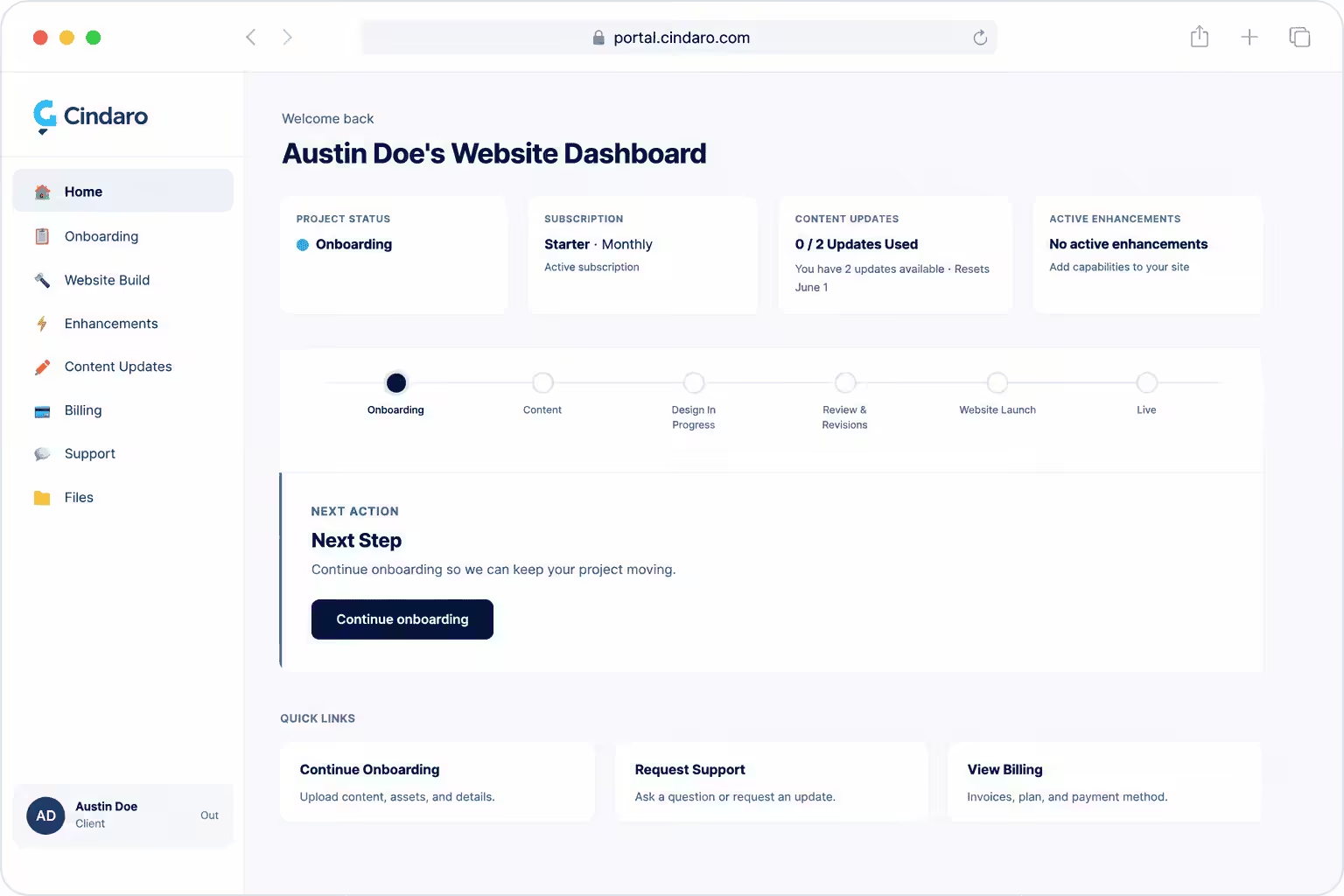
Businesses receive predictable monthly pricing and access to a centralized dashboard for onboarding, project progress, requests, approvals, and support. This creates a structured, long-term partnership—not another one-time website project.
Cindaro serves small businesses across a variety of industries and locations throughout the United States.
Frequently asked questions
More questions? Contact usWhat is the difference between a DIY builder and a professional designer?
A DIY website builder (like Wix, Squarespace, or GoDaddy) is a self-service tool: you choose a template and build, write, and maintain the site yourself. A professional web designer does that work for you — handling strategy, custom design, page speed, SEO, and ongoing updates so the site actually generates leads.
DIY builders keep the monthly fee low but cost you time and require you to be your own designer, copywriter, and tech support. A professional designer costs more but delivers a faster, better-converting site and takes the work off your plate. The middle ground many small businesses miss is a managed website service, where a professional builds the site and keeps running it for a flat monthly fee — which is what Cindaro provides.
Is a freelancer less expensive than a website agency?
A freelance web designer usually has a lower upfront price than a full agency, but the total cost often evens out. Freelancers typically charge $500–$5,000 per project; agencies charge $3,000–$15,000 or more. The difference is what’s included.
Freelancers rarely cover ongoing hosting, security, updates, backups, or support — so after launch you either manage the site yourself or pay hourly every time something breaks. Agencies bundle more in but bill large one-time project fees. A managed website provider like Cindaro is a third option: one predictable monthly price that covers the build, hosting, maintenance, security, and support, with no five-figure upfront invoice and no single freelancer to chase down when you need help.
What does a managed website service include?
A managed website service handles everything needed to keep your website online, secure, fast, and current — so you never have to touch code, plugins, or hosting settings. It’s the website equivalent of a property manager. It’s also called website as a service (WaaS).
A typical managed plan includes:
- Hosting, domain, and SSL certificate management
- Software, plugin, and security updates
- Daily backups and uptime monitoring
- Speed and performance optimization
- Content edits and small design changes on request
- Priority support from a real person
With Cindaro, managed plans also include ongoing SEO improvements and design updates as your business grows, so the site keeps getting better instead of aging out.
How much does a professionally managed website cost?
A professionally managed website typically costs between $100 and $500 per month, depending on the size of the site and what’s included. Entry-level plans cover hosting, updates, security, and backups; higher tiers add content edits, design changes, SEO work, and monthly reporting.
Cindaro’s managed plans start at $99/month with no large upfront build fee — replacing the $5,000–$15,000 one-time cost of a traditional agency project with a flat monthly rate that includes the build and everything after it. See current plans and pricing.
Want a Website That Is Managed After Launch?
Whether you are replacing an outdated website, moving away from DIY platforms, or looking for a more structured long-term solution, Cindaro helps businesses maintain a professional presence on the internet after their website is launched.