
Quick Takeaways
- Every page needs exactly one H1 that clearly states what the page is about — it’s one of the strongest on-page SEO signals available and is frequently missing or duplicated on small business websites.
- H2 subheadings aren’t just for readability — they tell Google what subtopics the page covers and support ranking for secondary keywords beyond the primary target.
- A clean, descriptive URL slug communicates the page’s topic to Google before a single word of content is crawled.
- Page structure is entirely within your control — unlike backlinks or domain authority, it doesn’t require external validation. It just requires consistent attention.
- Well-structured pages rank for more queries because they cover their topic more comprehensively and communicate that coverage more clearly to search engines.
How Page Structure Affects Your Search Rankings
Page structure for SEO is one of the most directly actionable areas of search optimization available to small businesses — and one of the most consistently neglected.
Most SEO conversations focus on content quality and backlinks. Both matter. But there’s a foundational layer that affects how well content performs in search regardless of its quality — how the page itself is organized, how its content is hierarchically presented, and how clearly it communicates its topic to search engines.
Page structure for SEO is entirely within your control. It doesn’t require external validation, years of relationship building, or a significant budget. It requires deliberate attention to how each page is built — and the discipline to apply that attention consistently across every page on the site.
Why Page Structure for SEO Matters — How Google Reads a Page
When Google crawls a page it doesn’t experience it the way a human visitor does. It reads the underlying HTML — the code that defines what each element on the page is, how it’s labeled, and how it relates to everything around it.
Page structure is what gives that code meaning. A well-structured page communicates clearly and efficiently: this is what the page is about, this is how the content is organized, these are the most important points, and this is how this page relates to the rest of the site.
A poorly structured page sends muddled signals — making it harder for Google to understand the topic, assess the relevance and quality of the content, and determine how prominently to feature it in results for the queries it should be targeting.
The practical implication is significant. Two pages with equivalent content quality will not rank equivalently if one is well-structured and the other isn’t. Structure is a multiplier — it determines how effectively the content’s quality translates into ranking performance.
H1 Tags — The Most Important Structural Signal
The H1 heading is the single most important structural element on any page for SEO purposes.
Every page should have exactly one H1 that clearly and specifically states what the page covers. The H1 is one of the primary signals Google uses to understand a page’s topic — it’s weighted more heavily than any other on-page text element in the ranking assessment. A page with a clear, keyword-rich H1 communicates its topic immediately and unambiguously.
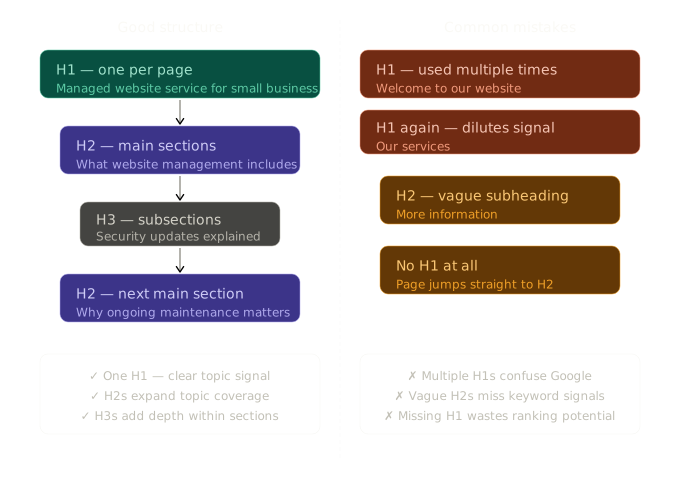
The most common H1 mistakes on small business websites are using multiple H1s on the same page, having no H1 at all, or having an H1 that’s vague or misaligned with the page’s target keyword. A service page with an H1 of “Welcome to Our Business” tells Google almost nothing about what the page covers. A service page with an H1 of “Managed Website Service for Small Business” tells Google exactly what it’s about and who it serves.
This connects directly to what a metadata guide for small business websites covers in terms of how structural elements signal topic relevance — H1 tags are metadata in the broadest sense, communicating topic to search engines as directly as title tags do.
H2 and H3 Tags — Structure That Supports Broader Ranking
H2 subheadings serve a dual purpose that most small business owners don’t fully appreciate.
Visually, they break up content into scannable sections that improve the reading experience. From an SEO perspective, they communicate to Google what subtopics the page covers — extending the page’s relevance beyond the primary keyword to a broader set of related queries.
A well-structured article with keyword-rich H2s will often rank for a significantly larger set of queries than a page where all the content is buried in unstructured body text — even when the word count and content quality are identical. The H2s act as additional topic signals that broaden the page’s relevance footprint in search.
For small business websites building topical authority through a content hub, this means H2 structure deserves deliberate thought rather than afterthought. Each H2 should reflect a genuine subtopic of the page’s primary focus, use natural language that reflects how searchers phrase related questions, and build a logical hierarchy that makes the page’s full scope immediately clear to both visitors and search engines.
H3s break down subsections within H2s — adding another level of structural clarity for longer, more comprehensive pages. The key principle at every level is the same: use descriptive, specific language that reflects what that section actually covers.
Let me show you what good header hierarchy looks like versus common mistakes:
URL Structure as a Page Structure Signal
Page structure extends beyond the content itself to the URL — and URL structure sends signals to Google about a page’s topic before a single word of content is crawled.
A clean, descriptive URL slug tells Google what the page is about immediately. cindaro.com/insights/how-page-structure-affects-search-rankings communicates the page’s topic clearly and specifically. A URL like cindaro.com/?p=4821 or cindaro.com/page2 provides no signal at all — and may actually create confusion about the page’s purpose.
The practical standards for URL structure are straightforward. Use lowercase letters and hyphens between words. Include the primary keyword naturally. Keep URLs as short as possible while remaining descriptive. Avoid stop words like “the,” “a,” and “and” where they don’t contribute meaning. Never use underscores — Google treats hyphens as word separators but treats underscores as connectors, meaning “page-structure” is read as two words while “page_structure” is read as one.
URL structure needs to be established correctly from the start. Changing URLs after a site is live — even with proper redirects in place — creates complexity that can temporarily affect rankings during the transition period. Getting it right initially is far simpler than correcting it afterward.
Content Organization and Topical Depth
Beyond headers and URLs, how content is organized within the page affects how Google assesses its relevance and quality.
A page that addresses a topic comprehensively — covering the main question and the related questions a searcher is likely to have — signals depth and authority. A page that answers a narrow question and stops signals limited coverage. Google generally favors pages that serve the full scope of a searcher’s intent over pages that serve only the most literal interpretation of their query.
This is why well-structured pages with multiple H2 sections covering different aspects of a topic tend to outperform shorter, less structured pages for competitive keywords — not because length is a ranking factor in itself, but because thorough, well-organized coverage of a topic naturally generates the relevance signals that support ranking for a broader set of related queries.
For small businesses building topical authority through a content hub, this means every article should aim to cover its specific topic thoroughly — not superficially. A page that answers five related questions about page structure for SEO provides more value to searchers and sends stronger topical signals to Google than a page that touches the topic lightly and moves on.
Internal Links Within Page Structure
How a page links to other pages on the site is part of its structural contribution to the site’s overall SEO health — and it’s where page structure intersects directly with internal linking strategy for small businesses.
Contextual internal links — links that appear naturally within well-organized content sections — carry more weight than links placed in navigation menus or footers. A link to a related article placed within the relevant H2 section of a well-structured page sends a clearer contextual signal than the same link placed at the bottom of the page in a “related articles” block.
For content hubs, this means structure and internal linking work together as a system. A well-structured article creates natural places for contextual internal links. Those links strengthen the connected pages. The connected pages link back — reinforcing the authority of the original article. The whole cluster builds topical authority more effectively than any individual page could on its own.
Page Structure as an Ongoing Responsibility
Page structure isn’t a one-time consideration applied at launch and then set aside. It’s an ongoing responsibility that needs to be applied consistently to every new page published — and audited periodically across existing pages as the site grows.
New pages published without deliberate structural attention accumulate the same common mistakes — multiple H1s, vague H2s, missing alt text, unoptimized URLs — that undermine ranking potential from the moment of publication. An audit of existing pages that identifies and corrects structural issues across the full content library can produce meaningful improvements in search visibility without publishing a single new piece of content.
Understanding why Google rankings change over time in the context of page structure shows why this ongoing attention matters — structural quality is one of the signals Google continuously re-evaluates, and a site whose structure improves over time sends consistently stronger signals than one that launched well and was never revisited.
Page structure is the layer of SEO that’s most directly within your control. Getting it right consistently — across every page, on every publish — is one of the highest-return SEO investments available to a small business with a growing content library.
Explore the complete small business SEO guide for everything covered in this category. Browse all topics at Cindaro Insights to explore the full library.
Cindaro builds and manages websites for small businesses as an ongoing service — which means page structure, header hierarchy, and URL configuration are treated as platform standards from day one, not afterthoughts that quietly undermine ranking potential. See how it works or view our pricing.