Looking local is a powerful trust signal—and it is surprisingly easy to fake. An agency operating from one office can appear to be a regional firm with a dozen branches, hundreds of reviews, and a phone number in your area code, even when those signals don’t reflect its actual operations.
Many of the tools involved are legitimate on their own: mailing addresses, coworking spaces, city landing pages, and call-forwarding numbers all have valid business uses. The problem begins when they are combined to create a misleading picture of where a company operates, who works there, or what customers have experienced. Some practices also violate platform rules or consumer-protection laws.
Here’s how the facade gets built—and how to examine it in about ten minutes.
Quick Takeaways
- “Local authority” can be assembled from parts: rented addresses, bulk reviews, keyword-stuffed profile names, and forwarding phone numbers.
- Each tactic is cheap and fast. Together they can make one small office look like a regional firm.
- Reviews are often the most persuasive piece. You cannot always prove they are real, but there are things to look out for.
- A Google Business Profile name is supposed to be your real business name. “Best Web Design [City]” isn’t one, and it’s against the rules.
- A local area code doesn’t mean a local office. Many route to a single central call center.
- The check is the same for all of it: verify one concrete thing instead of reading the marketing.
The rented address
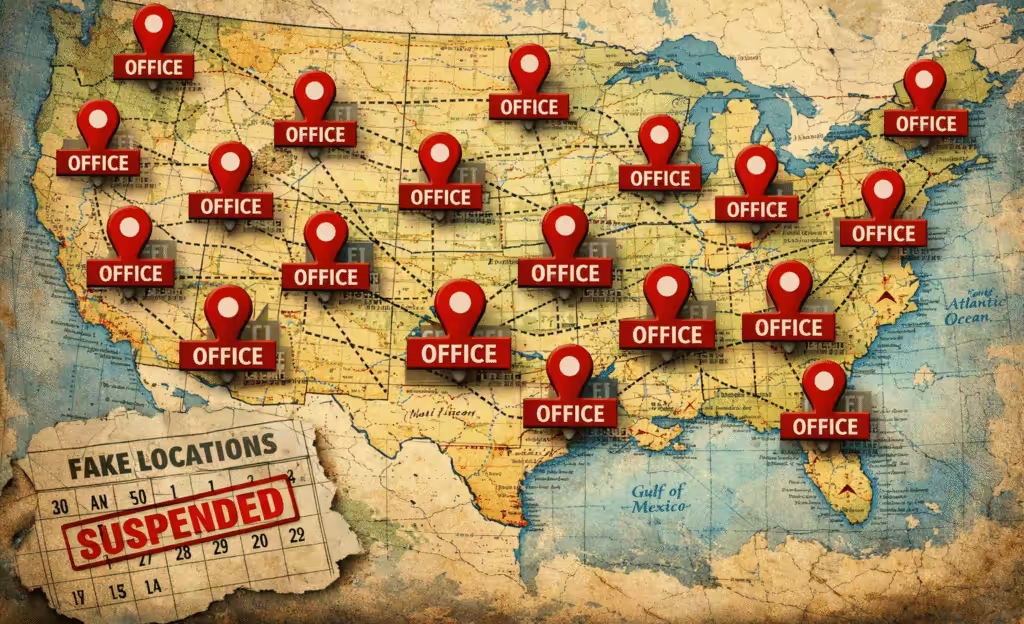
The most visible version of fake local presence is the map pin. An agency rents a virtual office address — sometimes a mailbox, sometimes a coworking desk that’s never staffed — creates a Google Business Profile for it, and shows up in the local results for a city where no one actually works.
Virtual offices are a legitimate tool. The problem is listing an unstaffed address as a staffed local office. The Map Is Full of Pins. Is Anyone Actually There? covers this one in full — how it works, why Google tolerates it for a while, and why it eventually collapses.
Reviews at scale
Fake reviews aren’t a back-alley thing anymore — they’re a product. Services sell Google reviews in packs of 5, 10, 20, 50, or 100, priced per review with a volume discount, 50–100 words each, written for you. The pricing page has a “Most Popular” tier and a “Best Value” badge, like any other checkout.
This isn’t hypothetical. On September 1, 2026, Cindaro received an unsolicited sales email promoting packages of 5, 10, 20, 50, or 100 Google reviews. The offer specified review lengths of 50–100 words and included scheduled delivery with every package.
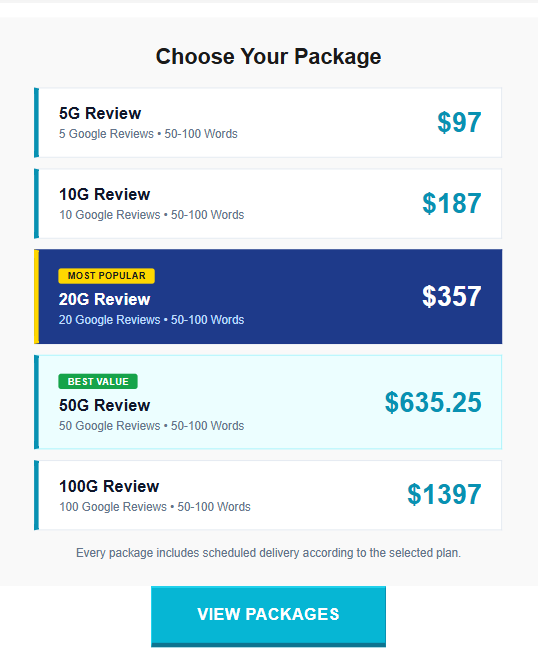
The revealing detail is scheduled delivery. Instead of delivering the reviews all at once, the service spreads them across a selected period. Although the email doesn’t state why, this would create a more natural-looking review pattern than an obvious one-day spike.
What manufactured reviews tend to share:
- A steady, unnatural cadence—a few reviews every week for months, with little variation
- Generic praise—“great service, very professional, highly recommend”—without specifics about the work, person, timeline, or problem solved
- Repeated phrasing and structure across different locations or businesses
- The same reviewer profiles praising multiple locations of one company, especially locations spread across distant cities or states
- Limited reviewer histories combined with repeated language, unusual timing, or implausible geographic patterns
- A suspiciously perfect rating with little variation in customers’ experiences
No single pattern proves that a review is manufactured. A customer may rarely leave reviews, travel frequently, or genuinely use the same company in different places. The stronger warning sign is repetition: multiple reviewer profiles covering distant branches, using similar language, or posting within the same compressed period.
Keyword-stuffed profile names
Keyword-stuffed names can influence visibility because they closely match what people search for. But Google requires a Business Profile name to reflect the company’s real-world name—not additional services, locations, or marketing language added solely to improve rankings. A profile name that reads like a search query instead of a business name is a sign that the company may be optimizing for the algorithm before accurately representing itself.
Phone numbers that aren’t local
A number with your city’s area code feels local, but it doesn’t establish that the company has an office there. Businesses can purchase local numbers and route calls to employees, remote teams, or centralized support centers. That practice is common and not inherently deceptive.
The issue is whether the number is presented as evidence of a local branch that doesn’t exist. If a company claims to maintain an office in your city, ask whether clients can visit it, who works there, and whether appointments are available at that address. The answers should match what the website and business listings claim.
Purchased credibility
Some trust signals can be obtained without demonstrating the quality of the company’s work:
- “Best of [City]” and “Top 10 Agencies in [City]” badges from directories that charge for placement, enhanced profiles, or awards
- Stock photographs presented in a way that implies they show the company’s actual team
- Sponsorships and memberships displayed without explaining the company’s actual involvement
None of these automatically indicates deception. The question is whether they supplement verifiable experience or substitute for it. Look for named team members, documented projects, specific client experiences, and evidence that the company does what it claims.
City pages that imply local offices
Some agencies create dozens or hundreds of city pages using nearly identical content. A city page is not inherently misleading. Service-area businesses can legitimately work across multiple markets and publish useful pages explaining where their services are available.
The concern is how the relationship is presented. Does the page truthfully say the company serves the city, or does it imply there is a local office, team, or branch that doesn’t exist?
Open several city pages and compare them. If only the city name, phone number, and a few landmarks change, the pages may have been created primarily to capture searches rather than provide meaningful local information.
What to actually look for
Before hiring any agency that presents itself as local or regional:
- Is there a real, named person you’d work with, or a support inbox and a rotating cast?
- Do the reviews describe real work — names, timelines, specific deliverables — or is it interchangeable praise?
- Call the number for your city during business hours. Who answers, and where are they?
- Would they let you visit, or video-call from, the office tied to your market?
None of this is unreasonable to ask a company that’s about to run your marketing for the next several years. If the answers are vague, that’s the answer.
The bottom line
Fake local authority works because checking it can feel rude, and most people don’t bother. But verification takes about ten minutes and requires no confrontation: read several reviews closely, compare a few city pages, and determine whether each claimed office is actually presented and operated as an office. A legitimate service-area business should be clear about where it is based, where it works, and what kind of presence it maintains. A misleading operation depends on customers never checking the difference.
Every Cindaro plan includes managed hosting, security, website maintenance, and ongoing support from day one — not as optional add-ons. See how it works, compare Cindaro to DIY builders and agencies, or view pricing to see what’s included.