
Quick Takeaways
- Search visibility describes how visible your website is across relevant search results — including how often it appears, where it ranks, and which searches generate impressions and clicks.
- Branded visibility and non-branded visibility are different — ranking for your company name is important, but appearing when potential customers search for your services, products, problems, and questions creates opportunities to reach people who don’t already know your business.
- Search visibility isn’t determined by one SEO factor. Content relevance, crawlability, indexing, site structure, internal links, authority, usability, and technical performance can all contribute to organic search performance.
- Google Search Console is one of the best places to measure organic search visibility because it shows the queries and pages generating impressions, clicks, click-through rates, and average positions in Google Search.
- Search visibility changes over time. Competitors publish new content, search behavior changes, websites change, and Google’s ranking systems evolve.
- Improving search visibility is an ongoing process involving useful content, sound technical SEO, internal linking, website maintenance, and continued measurement.
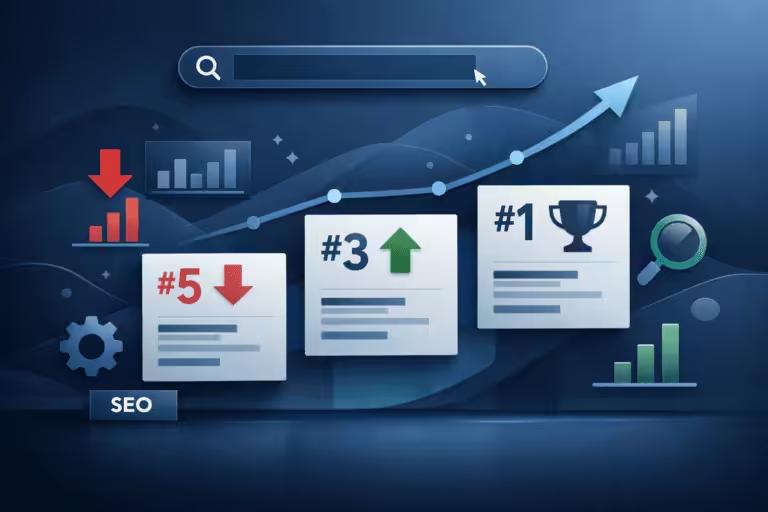
Search visibility is the percentage of all possible clicks from a set of searches that go to your website. If you ranked #1 for every keyword you care about, your visibility would be close to the highest score possible. If you don’t appear on page one for any of them, it’s close to 0%. Tools like Moz, Ahrefs and Semrush calculate it from your rankings and the typical click-through rate at each position.
If customers search Google for something your business provides, how likely are they to find your website?
A business with strong search visibility appears across relevant searches for its services, products, expertise, and the problems its customers are trying to solve.
A business with weak search visibility may have an excellent website and provide a valuable service—but remain difficult to discover unless someone already knows its name.
For small businesses, understanding search visibility is important because organic search can introduce your business to potential customers before they know your company exists.
What Is Search Visibility?
Search visibility is a way of describing how prominently a website appears across search engine results for queries relevant to the website or business.
It isn’t necessarily one individual metric.
Depending on the SEO platform or context, a “search visibility” metric may be calculated differently. Some SEO tools create proprietary visibility scores based on keyword rankings, estimated search volume, expected click-through rates, and other factors.
More broadly, search visibility describes your overall presence in organic search.
That can include:
- How many relevant searches your website appears for
- How prominently your pages rank
- How many search impressions your pages receive
- Which pages appear in search
- Which queries trigger your pages
- How much organic traffic those searches generate
This distinction matters.
A website doesn’t simply have a single Google “visibility score.” Different SEO tools may calculate visibility differently, while Google Search Console provides actual search-performance data such as impressions, clicks, click-through rate, and average position.
Why Does Search Visibility Matter?
Search visibility determines whether potential customers have an opportunity to discover your business through search engines.
Imagine two companies offering essentially the same service.
One appears when customers search for the service, ask related questions, compare solutions, and research problems.
The other appears only when someone searches for its exact company name.
Both technically exist on Google.
But their ability to attract new customers through organic search is dramatically different.
Strong search visibility can help a business:
- Reach potential customers who don’t know its name
- Generate organic website traffic
- Build awareness around its services
- Appear during customer research
- Generate leads and inquiries
- Reduce reliance on paid traffic
- Establish expertise around important topics
This is why search visibility should be considered more broadly than simply asking, “What position do I rank for this keyword?”
One ranking is only one small part of your overall presence in search.
Branded vs. Non-Branded Search Visibility
One of the most useful ways to understand search visibility is to separate branded and non-branded searches.
Branded Search Visibility
Branded searches include your company or brand name.
For example:
Cindaro
or:
Cindaro website management
Someone performing that search already knows about the business.
Appearing prominently for your own brand is important, but branded visibility primarily helps people who have already discovered you somewhere else. If your business doesn’t appear even when you search its exact name, see why your business isn’t showing up on Google.
Non-Branded Search Visibility
Non-branded searches don’t include your company name.
Examples might include:
website management for small businesses
why is my website slow
how does website caching work
small business website maintenance
These searches can introduce your business to someone who has never encountered it before.
That’s what makes non-branded search visibility particularly valuable for customer acquisition.
The person has expressed an interest, problem, or need relevant to your business—and search gives you an opportunity to reach them during that process.
Search Visibility vs. Search Rankings
Search visibility and search rankings aren’t the same thing.
A ranking describes where a particular webpage appears for a particular search.
Search visibility considers your presence across a broader collection of relevant searches.
Suppose your website ranks #1 for one keyword but appears for almost nothing else.
Another website ranks between positions #3 and #10 for hundreds of relevant searches.
Which has greater overall search visibility?
Potentially the second website.
That’s why tracking only a handful of individual keyword positions can provide an incomplete picture of SEO performance.
A healthier approach is to evaluate:
- Keyword rankings
- Search impressions
- Organic clicks
- Click-through rates
- Pages receiving search traffic
- Queries generating visibility
- Changes in those metrics over time
Together, these provide a much better picture of whether your presence in search is actually growing.
How Is Search Visibility Calculated?
Every SEO tool does the math a little differently, but the method is the same:
- Pick a keyword list. Visibility is always measured against a set of searches you track, not all of Google.
- Find your position for each keyword.
- Apply an expected click-through rate. Position 1 gets the biggest share of clicks, position 10 gets very few, and page two gets almost none.
- Weight by search volume. A keyword with 1,000 monthly searches counts more than one with 10.
- Divide by the maximum possible. That’s the clicks you’d get if you ranked #1 for everything.
The result is a percentage. Because it depends on your keyword list, a visibility score from one tool can’t be compared with another tool’s, or even with your own score after you change the list.
What Is a Good Search Visibility Score?
There’s no universal “good” number, because the score depends on the keywords you track. As a rough guide for a small business tracking its core service and location searches:
| Score | What it usually means |
|---|---|
| Under 5% | You rarely appear on page one. Common for new sites. |
| 5–20% | You’re on page one for some searches but not near the top. |
| 20–40% | Strong. You hold top positions for several important searches. |
| 40%+ | You dominate your keyword list. Usually means it’s time to track more keywords. |
Can you reach 100%? Practically, no. You’d need position 1 for every keyword, and ads, map packs and AI Overviews take clicks even from the top organic result. The useful signal is the trend: is your score rising month over month?
How Do You Measure Search Visibility?
There are several ways to measure search visibility, depending on what you’re trying to understand.
Google Search Console
Google Search Console is one of the most useful sources because it provides information about how your website actually performs in Google Search.
Its performance reports can show:
- Impressions — how often your pages appeared in search results
- Clicks — how often searchers clicked your result
- Click-through rate (CTR) — the percentage of impressions that generated clicks
- Average position — the average position of your highest result for a query
You can also examine:
- Individual search queries
- Individual pages
- Devices
- Countries
- Search appearance
- Changes over different date ranges
If impressions for relevant non-branded searches are increasing over time, that’s one indication that your search visibility is expanding—even before all of those impressions turn into clicks.
Keyword Rank Tracking
SEO tools can monitor where your website ranks for selected keywords.
This is useful when you have a specific set of commercially important searches you want to monitor.
For example, a local business might track variations of its primary services combined with important locations.
Rank tracking provides a more controlled view than Search Console because you’re monitoring the same keyword set over time.
However, it shouldn’t be your only measurement.
Your website can begin appearing for hundreds of searches you weren’t explicitly tracking.
Organic Search Traffic
Organic traffic shows how many visitors actually reach your website through unpaid search results.
Increasing organic traffic can indicate improving search performance, but traffic alone still doesn’t tell the entire story.
A page attracting 5,000 irrelevant visitors isn’t necessarily more valuable to a business than one attracting 100 people actively searching for the service the company provides.
Relevant visibility matters more than visibility for its own sake.
What Affects Search Visibility?
Search engines evaluate many signals when deciding which pages to show for a search.
There isn’t one setting that creates search visibility.
Instead, several areas of SEO work together.
Content Relevance and Quality
Search engines want to provide results that satisfy what the searcher is trying to accomplish.
That means your content needs to match the search intent behind the query.
A page should clearly answer the question, explain the topic, provide the requested information, or present the relevant service or product.
Publishing more content doesn’t automatically create better search visibility.
The goal should be to create useful pages that address topics genuinely relevant to your audience and business.
Over time, a collection of interconnected, useful resources can help a website build a stronger presence across searches related to its area of expertise.
Crawlability and Indexing
Before a webpage can generate organic search visibility, search engines generally need to discover and index it.
Technical problems can interfere with that process.
Examples include:
- Accidental
noindexdirectives - Incorrect canonical tags
- Broken internal links
- Redirect problems
- Robots.txt restrictions
- Server errors
- Duplicate or inaccessible URLs
A beautifully written page has little opportunity to attract organic search traffic if Google can’t properly access or index it.
That’s why SEO for small business websites begins with a technically sound website foundation.
Internal Linking and Website Structure
Internal links connect the pages on your website.
They help visitors discover related information and help search engines understand relationships among your pages.
For example, a comprehensive website-performance guide might link to more focused resources about:
- Website caching
- Core Web Vitals
- Mobile performance
- Slow websites
- Third-party scripts
- Website downtime
Those specialized resources can then link back to the broader guide and to other closely related articles.
This creates a logical content structure rather than a collection of isolated pages.
Page Titles and Search Snippets
Page titles help communicate what a page is about and are an important part of how pages appear in search.
Meta descriptions can influence how your result is presented, although Google may generate a different snippet depending on the search.
Clear titles and descriptions can also affect whether someone chooses your result after seeing it.
Our metadata guide for small business websites explains these elements in greater detail.
Website Performance and User Experience
Website performance is part of the overall experience your website provides.
Google’s Core Web Vitals measure aspects of loading performance, responsiveness, and visual stability.
Performance isn’t a substitute for relevant, useful content, and a faster website doesn’t automatically outrank a slower competitor.
But maintaining a fast, accessible, usable website removes technical friction for visitors and contributes to a stronger overall website foundation.
Learn more about website performance for small businesses.
Authority and Reputation
Search visibility also depends on signals beyond your own website.
Links and mentions from other relevant, reputable websites can help search engines understand the prominence and credibility of pages and websites.
For local businesses, search visibility can also extend beyond traditional organic results into local search features, where factors such as business information, relevance, prominence, and location can matter.
This is another reason search visibility shouldn’t be reduced to simply adding keywords to a webpage.
Why Does Search Visibility Take Time to Build?
Search visibility usually develops gradually.
Search engines need to:
- Discover your pages
- Crawl them
- Index eligible content
- Understand what the pages cover
- Evaluate them against competing pages
- Revisit them as the web changes
Meanwhile, your website is building more content, acquiring links and mentions, strengthening its internal structure, and accumulating performance data.
For a newer website, this process can take time.
There isn’t a universal number of months after which a website suddenly becomes “visible.” Competition, industry, website history, content, authority, location, and the queries being targeted can all affect how quickly results develop.
That’s why SEO should generally be evaluated as a longer-term process rather than judged based on a few days or weeks of rankings.
Why Does Search Visibility Change?
Search visibility isn’t permanent.
Even a page that currently ranks well can move.
Common reasons include:
- Competitors improving their pages
- New competitors entering the results
- Search intent changing
- Google ranking-system updates
- Website technical problems
- Content becoming outdated
- Internal-linking changes
- Pages being added or removed
- Changes to the search results themselves
Sometimes a ranking change doesn’t indicate that anything is “wrong.”
Search results are dynamic.
Understanding why Google rankings change over time can help distinguish normal fluctuations from changes that deserve investigation.
Why Is My Search Visibility Zero? Check This WordPress Setting First
If your site doesn’t show up in Google at all, check one setting before anything else. In WordPress, go to Settings → Reading and look for Search engine visibility. If “Discourage search engines from indexing this site” is checked, WordPress tells search engines not to index your pages.
This box is often left checked after a site is built on a staging copy and then launched. To fix it:
- Uncheck the box and click Save Changes.
- In Google Search Console, use URL Inspection on your homepage and click Request Indexing.
- Submit your sitemap under Sitemaps if you haven’t already.
Your pages can take days to a few weeks to appear after you uncheck it. Other common causes of zero visibility are a noindex tag added by an SEO plugin, a robots.txt block, or a brand-new domain Google hasn’t crawled yet. Learn more about how Google indexes your website.
How to Improve Search Visibility
Improving search visibility starts with understanding where your website currently appears and identifying where relevant opportunities exist.
A practical approach includes:
- Make sure important pages can be crawled and indexed.
- Research what potential customers actually search for.
- Create pages that genuinely satisfy those searches.
- Use descriptive page titles and clear heading structures.
- Connect related pages with useful internal links.
- Maintain website performance and technical health.
- Earn relevant mentions and links when possible.
- Monitor Google Search Console for impressions, clicks, queries, and pages.
- Update important content when it becomes outdated.
- Measure progress over meaningful periods rather than reacting to daily ranking fluctuations.
The objective isn’t simply to rank for as many keywords as possible.
It’s to increase your visibility for searches that matter to your audience and your business.
Search Visibility FAQs
What is search visibility in SEO?
The share of possible clicks from a tracked set of searches that your site earns, based on where you rank.
What is a search visibility score?
That share expressed as a percentage, calculated by an SEO tool from your rankings, expected click-through rates and search volume.
Is search visibility the same as rankings?
No. Rankings are your position for one search. Visibility combines all of your rankings into one number, weighted by how many people search each term.
Why did my search visibility drop?
Usually because you lost positions on high-volume keywords, a competitor moved above you, or your tool’s keyword list changed. Check rankings for your biggest keywords first. See why your Google ranking changes.
Is GoDaddy’s Search Engine Visibility worth it?
GoDaddy sells a paid SEO tool under that name. Tools like it can walk you through basics such as titles and descriptions, but they can’t make Google rank you. Rankings still come from useful content, a fast site and links from other sites.
Search Visibility Is an Ongoing Process
Search visibility isn’t a box you check when a website launches.
Websites change. Competitors change. Search behavior changes. Google changes.
Maintaining organic visibility therefore requires continued attention to the website itself and to how people are discovering it through search.
That includes maintaining technical health, publishing and improving useful content, strengthening internal links, monitoring indexing, reviewing search-performance data, and responding when important pages begin losing visibility.
The strongest search visibility comes from treating SEO as an ongoing part of maintaining and improving the website—not as a one-time project with a completion date.
Explore our complete small business SEO guide or browse additional topics at Cindaro Resources.
Cindaro builds and manages websites for small businesses as an ongoing service — which means search visibility is supported continuously through technical health, performance monitoring, and SEO foundations that stay in place long after launch day. See how it works or view our pricing.